Case Study · Full Stack Developer · since January 2026
Celina: a live two-sided marketplace, built solo, from first commit to production
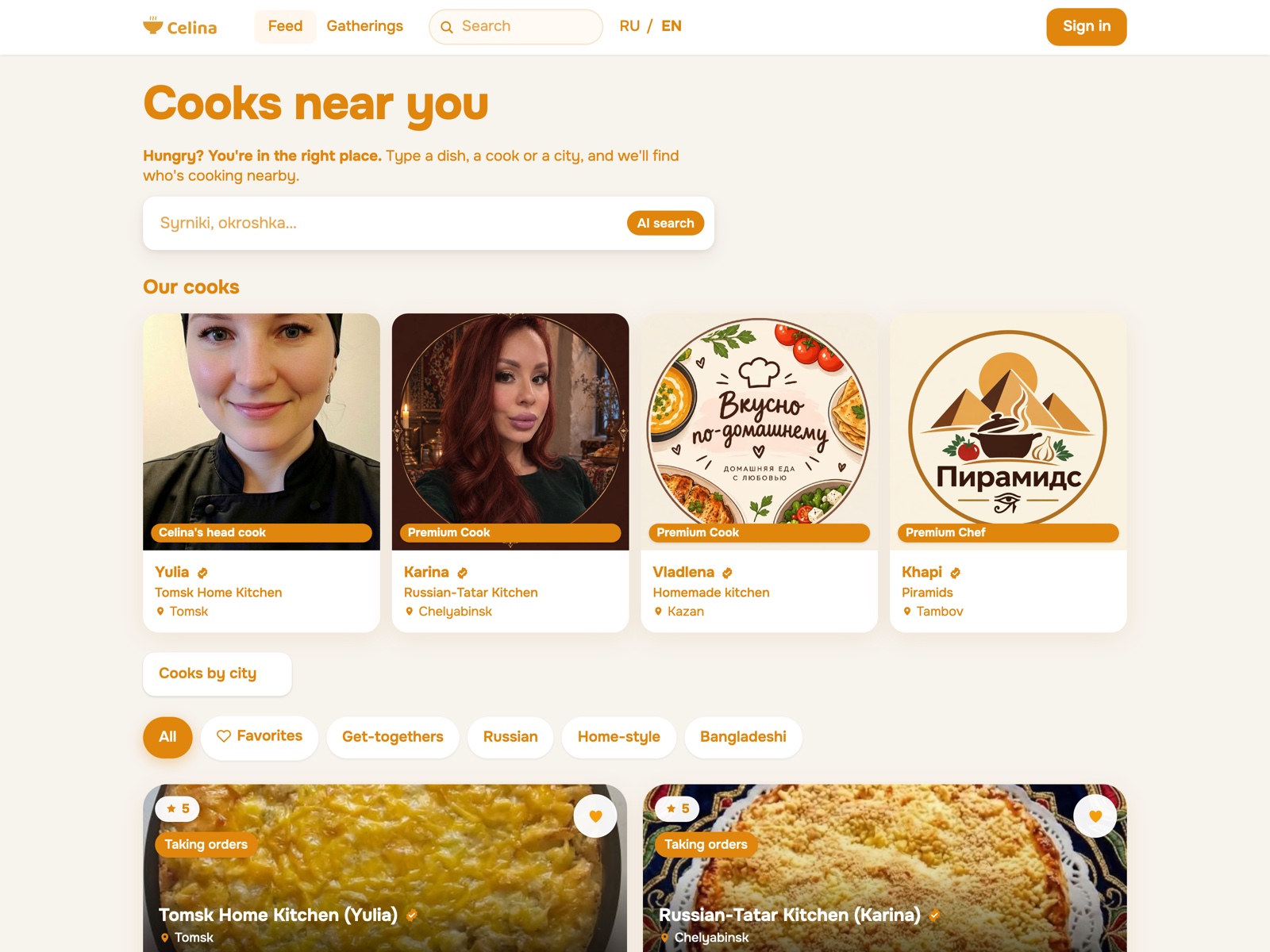
Celina is a consumer marketplace connecting home cooks with customers. I built it in Lisbon, Portugal, from January 2026 and launched it from there in July 2026; today I run it from Geneva. I built every layer of it — product design, frontend, backend, infrastructure, SEO, and analytics — and operate it in production. Verified cooks are selling on it today, with their own public kitchen pages — so what you see is a real product with real sellers on it, not a demo.
The challenge
A two-sided marketplace is a demanding thing to ship as a solo developer. It needs seller onboarding with identity verification, a catalog customers trust, ordering with real-time status, security that protects both sides, and — the part most builds skip — the ability to be found: a marketplace nobody discovers on Google is dead on arrival.
Both sides have to work from the first day: cooks who sign up and have their identity checked, and customers willing to order from someone they have never met. Neither group waits around while the other half of the product is built.
- Two audiences, one product. Cooks need a working tool, customers need a shop, and both run on the same codebase.
- Trust before the first order. Without identity checks on the cooks, nobody orders food from a stranger.
- Findable from day one. No organic traffic means no supply, and no supply means no traffic.
- One developer, not a team. Every technical decision had to be one that a single person can keep running.
The frontend: a React app Google can read
A marketplace lives on organic traffic, but a classic single-page app hands the crawler an all but empty HTML document. So the frontend is React 18 and TypeScript, generated statically with Vite: the visitor gets an app, the search engine gets finished HTML.
That produced a site of more than 170 pages across eleven countries, bilingual, with the landing pages prerendered and indexed by both Google and Yandex. On every deploy the site submits its new and changed pages through IndexNow, so a page never sits waiting for a crawler to come past by chance.
- React 18, TypeScript and Vite with static generation: 170+ pages served straight as HTML, and every kitchen and dish page rendered on the server.
- Structured data per kitchen and per dish — FoodEstablishment, Menu, Offer, opening hours and breadcrumbs — so a single dish can be found on its own.
- IndexNow on every deploy, so new pages announce themselves to the search engines instead of waiting to be found.
- One codebase for three roles — customer, cook and administrator — each with its own view.
- Phone first. The ordering flow was designed for the phone and only afterwards for the large screen: an app-style bottom bar, and an install prompt that puts the site on the home screen as a PWA.
The backend: orders, identity and access
Behind it runs Node.js with Express and Prisma on MySQL. The center of the system is the order lifecycle: from placed to delivered, with a status both sides watch in real time. As long as the customer can see where the order is, nobody has to pick up the phone.
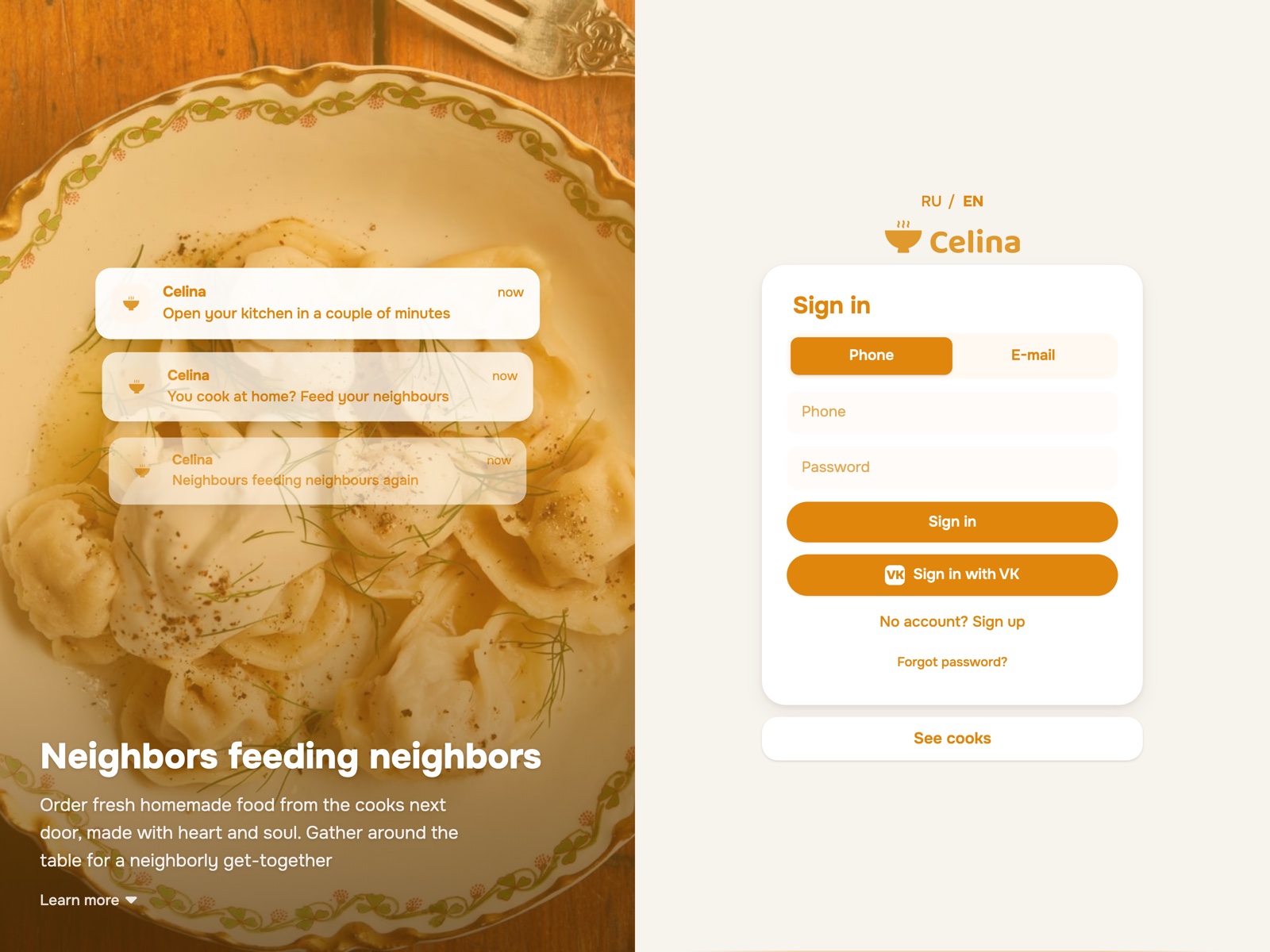
Cooks go through a KYC process: they upload an identity document, and it is reviewed before their kitchen becomes visible. Permissions are enforced on the server rather than in the interface — whatever the browser hides, the server blocks as well.
- Node.js, Express and Prisma on MySQL, with an order status that runs from placed to delivered.
- KYC for cooks: upload the document, review it, and publish the kitchen only after that.
- Roles checked on the server, so a request edited in the browser buys nothing extra.
- Sessions across several devices, with the option to end any of them remotely.
The infrastructure
The application runs in Docker containers behind nginx on a VPS of my own, with Let's Encrypt certificates that renew themselves. A deploy is a single command, so there is no manual step left for me to forget. Every night a backup of the database and the uploaded documents runs on its own.
I also measure the whole funnel: visit to catalog, catalog to order. Together with the Search Console data, that is what decides which pages get attention — not my instinct.
- Docker, nginx and Let's Encrypt on a VPS.
- Automated deploys, so a release is not a checklist of manual work.
- Daily backups of the database and the uploaded files.
- A funnel I can measure: from visit to catalog to order, wired to Search Console.
Choices and trade-offs
Every choice in this project had a price. Static generation makes the landing pages findable, but every change to them needs a new build; that is acceptable only because the build is automated. Reviewing KYC by hand does not scale forever, but at this stage an external verification service costs money that is better spent on the product itself.
Just as important is what I deliberately did not do: no Kubernetes, no microservices, no extra service with a monthly subscription. At this volume, one server, one database and a monolithic backend are the cheapest option and the easiest to maintain — and I am the one who gets out of bed at night when something breaks.
- Static generation for the landing pages, server rendering only where content changes (kitchen and dish pages): slower to publish, faster and cheaper for the visitor.
- KYC reviewed by hand instead of a paid verification service, until the volume justifies one.
- One VPS instead of a cloud platform, for predictable costs and no dependence on a single vendor.
- A monolith instead of microservices, because there is one developer here and not five teams.
Results
Celina is no longer a system that could take sellers — verified cooks are selling on it. Three kitchens have public pages right now — in Tomsk, Chelyabinsk and Kazan — with nine individual dish pages beside them, and a cook joins the wall on the front page automatically once the identity check is done. Each of those pages is rendered on the server as finished HTML and carries FoodEstablishment and Menu structured data, so every kitchen and every dish is findable on its own rather than only through the catalog. The site itself has grown to more than 170 pages across eleven countries, in two languages. Design, build, deployment and day-to-day operation are all on one person.
What matters more than the numbers is what does not happen. There is no agency to call when something breaks, no platform that raises its prices halfway through, and no part of the stack I cannot repair myself. The source is public too — the whole production system on GitHub, not a sample.
What this means for your project
The expensive parts of a project like yours — authentication, payment-ready order flows, verification, deployment, SEO — are ones I have already solved in production under my own name. You are not paying me to learn on your budget.
I work remotely and in English from Geneva, Switzerland. Prices are in Swiss francs or euros and fixed before anything starts, and data protection under the Swiss FADP and the GDPR is part of the design from the first sketch: no third-party trackers you did not ask for, analytics that is not loaded before consent, and hosting in a region you choose.
- A fixed price up front. From CHF 890 (€950) for a one-page personal site, CHF 1,490 (€1,590) for a landing page, CHF 2,900 (€3,100) for a business website with technical SEO and CHF 8,900 (€9,500) for a web application.
- A quote within 48 hours, agreed before the work begins; messages get an answer within 24 hours.
- Working hours that overlap yours. I am on Central European Time, the same clock as Zurich, Berlin and Paris; for the US East Coast your 9 a.m. is my 3 p.m., so we share your morning.
- Progress you can watch. A live staging link you open yourself, with WhatsApp, email or video calls in between — never a status email you have to wait for.
- You own everything. Code, design and data transfer to you on final payment — no license, no lock-in, and no monthly fee to keep using what you already paid for.